Academic Reviews for Le Morte Darthur Knight of the Cart
I've been writing the Classics Review section for several months, but I've been a writer here at Geeks Under Grace for more three years now. To be frank, few reviews have been equally challenging as this one. Classics are ever difficult. On the other hand, near novels accept ways of making its story coherent for a first-time reader.
That'south arguably less truthful with the King Arthur mythos. The legend is so vast and complex. It'due south immensely hard to gather even a basic understanding of the canon without intensive reads into archaic and forgotten books of lore. These tomes are themselves cached in dumbo medieval symbolism. Considering of that, I had to do MONTHS of research into the topic of Male monarch Arthur to become a sense of this one book, its human relationship to the greater Arthurian catechism, and how the volume fits as a singular work of authorship, satire, and storytelling.
I can't argue with the results, though. I am not sure I would call this a peculiarly well-crafted slice on Sir Thomas Mallory'due south magnum opus. However. it is a comprehensive ane that I hope tin can provide readers with a sense of context that might encourage them to give the book a hazard!
Content Guide
Spiritual Content: The book is set in Catholic Britain, and all of its characters are practicing Catholics. Religious adherence, loyalty, and faith are important themes in the story.
Violence: Pregnant activity, jousting, sword fights, stabbing, smiting, and warfighting with characters dying somewhat brutal deaths
Language/Crude Humor: None
Sexual Content: Arthurian stories frequently wrestle with themes of adultery and lust
Drug/Alcohol Use: Characters frequently potable vino at dinners for merrymaking
Other Negative Themes: Themes of death, evil, disloyalty, infidelity, murder, and selfishness
Positive Content: Themes of beloved, religion, loyalty and gamble

Review
There are many classical texts the Arthurian scholars will turn to when coming to sympathize the history of the Rex Arthur legend. Geoffrey of Monmouth's The History of the Kings of Britain, Chretien De Troyes'southward French Arthurian romance poesy, the Welsh Mabinogion and anonymously writtenVulgate Cycle remain some of the oldest sources we still accept in print for understanding the mythical British king. Sadly, this doesn't tell usa much nearly history. Most of what we know about Arthur comes from fan fiction written about him. From 1100-1250, Arthurian poetry was amongst the most popular and copied stories among the courts of French republic, Germany, England, Wales, and the greater part of Europe. Equally eccentric as many of these fanciful stories were, they tend to treat the character with more than reverence and more often than not have information technology for granted that Arthur was a real king during the 5th century, during the time when England was freshly abandoned past the Roman Empire and facing an onslaught of foreign invasions from Scandinavian Vikings.
In contempo centuries, nosotros've received updated versions of the myth that play upward the ahistorical nature of the character like Lord Alfred Tennyson'south Idylls of the King, Marion Bradley's The Mists of Avalon, and T.H. White'southward five-part epic The Once and Future Rex. These stories care for him with less credulity but explore the stories as literature.
The bridge to understanding Medieval romance, Victorian poetry, and 20th-century prose literature surrounding the fable of King Arthur can be found in a single book. Thomas Mallory's Le Morte D'Arthur (translated from French as The Death of Arthur) is the bridge connecting classical Arthurian poetry to mod Arthurian literature over the last i 1000 years. Information technology stands among the most influential and dear works of Western literature in being alongside Canterbury Tales, Paradise Lost, Village, and the Male monarch James Bible. Every version of Arthur that'south come out since the 19th century has in some manner been indebted to this massive work of talent.
But what is Le Morte D'Arthur? The answer to that can be establish in the volume's original title: The Whole Volume of King Arthur and of His Noble Knights of the Round Table.
Le Morte D'Arthur is one of the few works of Arthurian storytelling that tells the entire story of the ascent and autumn of Camelot and the Round Tabular array, from its formulation to its inevitable destruction. It'southward an enormous, m-page long epic that leaves few stones unturned in the entire canon of the Arthurian genre. It mixes and remixes dozens of Arthurian sources from multiple cultural traditions (Latin, Welsh, English language, French, and then on) and in some fashion depicts almost every major event from every major Round Table story. While there are Arthurian stories similar Parzival, Tristan, Knight of the Cart and Sir Gawain and the Light-green Knight that more intimately focus on private characters and stories in the mythos with greater depth, few Arthur stories offering such a variety.
Sir Thomas Mallory and The War of the Roses
Few stories in the canon overtly grapple with the "Matter of Britain" more than sharply and intimately than Le Morte D'Arthur. The epic was written 2 hundred years after the golden age of Arthurian poetry. At that time, the poems and romances were being written in the firsthand backwash of the Crusades. Those stories grappled with contemporary issues of Catholic doctrine, medieval concepts of marriage and courtly dear, and the implications of the Muslim earth's clash with Christendom. In 1485, a very different political situation was ongoing in England – the War of the Roses.
Nowadays, people mostly know of the War of the Roses as the Machiavellian inspiration for Game of Thrones. From 1455 to 1487, the royal families in England of the Lancasters and the Yorks engaged in a long series of encarmine civil wars and succession crises. This ultimately resulted in the 2 homes marrying and becoming the Tudor family unit, which ruled until the expiry of Queen Elizabeth I in 1603.
The enigmatic author of Le Morte D'Arthur was one Sir Thomas Mallory. History has not been kind to Mr. Mallory. The book's publisher William Caxton refers to him as a knight prisoner. Across that, we don't know that much about Mallory. There were several individuals in Britain with that name who technically could've been the poet in question. What's of import, though, is that history records a few details of Mallory'southward actions that are distinctly odd. We know that Sir Thomas Mallory was a veteran of the State of war of the Roses and that he was arrested and placed in prison house for thievery, murder, rape, and conspiracy. Information technology's believed that Mallory was either an excessively unruly knight who betrayed one of the royal families or that he had been an honorable knight who was falsely framed for a long list of crimes due to his associations in the purple courtroom. Regardless, he was imprisoned from 1460-1469 and ready nearly using his time to write a work of considerable nobility.
Le Morte D'Arthur is get-go and foremost a political satire. Information technology'south an adventure story and a story of Christian morality too. All the same, the volume's thematic weight and emotional through line most make sense when viewed as a contemporary work of criticism. The late Professor Charles Moorman of the University of Southern Mississippi writes that Sir Mallory "to fix down in English a unified Arthuriad which should have every bit its slap-up theme the nascency, the flowering, and the decline of an near perfect earthy civilization." Information technology's a story epitomized past "the failures in love, in loyalty, in organized religion."
Information technology's worth remembering that the Arthurian mythos was e'er a story about a tragic decline of a corking civilization. The nostalgic Welsh poets who outset wrote poems about the mysterious King Arthur were writing about a warrior whose claim to fame was that he died in battle facing the Viking invasions from Saxony. It was e'er a myth near a great king's lament for a civilization that was destroyed violently and tragically. With the pass up of Rome and the rise of Christianity, these themes meant something new to 12th century and 15th century Europeans who as well faced massive wars and existential crises within and without their cultures.
Equally nosotros'll come to meet, Sir Mallory's incredible genius came in his ability to mold the ideas, instincts, and fears that subtextually stewed underneath the Arthurian mythos and get in into a story nigh why the War of the Roses was destroying Great britain. He tied the very modern (circa 1485) issues of religion, love, wedlock, loyalty, and war into a mythos that had been growing, mutating, and expanding for a millennium. Like all nifty writers, he took an old story and made it new once more. It has since inspired centuries of readers.

A Note on Transcripts and Editions
When I first gear up out to brainstorm studying King Arthur, I didn't realize just how deeply the issue of transcripts and editions would become in my research. Le Morte D'Arthur took off in a Large manner in the 19th century. It was republished for the offset fourth dimension in several centuries, but even then information technology was a hefty creature. Information technology was barely attainable to lay readers at the time, despite the fact that the intellectual classes were buying copies of the volume in droves. Peachy authors similar Mark Twain and Tennyson were smitten by the text and immediately set to writing their own renditions of King Arthur.
In an endeavour to make the original Mallory text more marketable, dozens of authors from the late 19th century to modern-day ready virtually creating their own editions of the book that they could sell to uneducated readers. The most famous version of this was Sir James Knowles'due south publishing of The Story of King Arthur in 1860. Since then, we've seen other prominent editions of the story like Sidney Lanier's The Male child'due south King Arthur. In 1976, the late novelist John Steinbeck's estate published his version of the book titled The Acts of King Arthur and His Noble Knights, which was incomplete just retold the events of the original novel somewhat loyally.
Abridgments, reprints, and rewrites of Le Morte D'Arthur are extremely mutual. At used bookstore, information technology'southward possible to see several different versions of the volume lined upwards with no clear distinction as to which is which. I barbarous trap in this mess when I bought my first edition of the volume earlier this year. Instead of a proper text, I purchased Keith Baines's severely abridged "rendition in modern idiom" from 1988. It's only half every bit long as the full text, and I've seen abridgments every bit modest as 200 pages in used bins. Finding a concise, full text of the original book can be challenging if y'all don't know what you're looking for.
Thankfully it's not impossible to find comprehensive editions. Thomas Mallory's ubiquity has meant that he is an immediate favorite for reprint houses. Any Barnes and Noble is probably going to have a consummate copy of Le Morte D'Arthur in the $5 paperback classics bin alongside others like Pride and Prejudice, Frankenstein, Brothers Karamazov, and more. (I constitute a used $ii edition of the Borders reprint at a local bookstore this past week!) The downside is but that you're trading availability for quality. Some reprints of Mallory are downright baffling, like the Penguin Classics edition that bizarrely splits the book into two 450 pages volumes for no discernible reason.
What complicates things further is that there are two academically recognized texts of the full volume that exist. In 1934, Due west.F. Oakeshott discovered a mysterious transcript of the book which would go on to be called "The Winchester Manuscript". It had been lost in a university library for the ameliorate office of 500 years and suddenly appeared earlier the bookish globe as a long-lost version of the book that could modify the way audiences understood Sir Mallory.
As C.Southward. Lewis writes, Oakeshott "secured something not different immortality to his name and also reduced the study of Malory to a state of suspense for thirteen years. During that menstruation, naught could exist said about the Morte D'Arthur without a reservation; no one knew what the Winchester Manuscript… might refute or confirm."
When the manuscript was published, with commentary, in 1947, it became the talk of the intellectual world. As they discovered, the Winchester manuscript was the version of the volume that had been handed to Sir Mallory's publisher William Caxton in 1485. At this point, Mallory was dead, and the book could no longer be defended as a piece of work independent of its publisher. The manuscript'south content makes information technology clear that the publisher wanted to change elements of the novel to make it easier to sell to lay readers. Sir Mallory had written an aristocratic satire. Caxton wanted to sell a knightly adventure story for the masses that could teach the laity near the lives of the aristocracy and how to emulate knightly beliefs. Sir Mallory'due south text wasn't entirely mutilated, simply sections of the book were left on the cutting room flooring or rearranged while loose narrative threads that Mallory hadn't finished were trimmed. Caxton even rewrote a handful of sections to make them more cohesive as a singular novel. He changed the proper name from Mallory'southward original championship to Le Morte D'Arthur, which was an editing mistake as he took the title of the concluding chapter and believed information technology to be the title folio.
It's hard to debate with the results, though. The published text of Le Morte D'Arthur became the definitive English language text on the life of King Arthur for the adjacent half a millennia. Information technology remains unsurpassed to this day in popularity and depth. Maybe the volume dear the world over ought to exist regarded as Caxton's work every bit as Mallory's. Regardless, I hope this digression offers some insight into the problem of editions. A reader who wants to read the novel will need to track down a serviceable complete text of the book or at the very least should be enlightened that the edition they may be buying is an abridged edition.
The Story Office ane: The Youth of Arthur Pendragon and his Conquest of Rome
Let's kickoff our usual breakdown of the narrative. Traditionally, editors intermission upwardly Le Morte D'Arthur in 1 of ii ways: 8 books or 21 books. For the sake of give-and-take, I'thou primarily going to discuss the narrative of the book in its overall structure and movements. In that sense, I think you lot tin reasonably break the volume downwards into 4 of import structural points – the origin of Camelot, the gilt age of Camelot, the Quest for the Holy Grail, and the destruction of Camelot. This is probably over-generalizing a VERY long narrative, but for the sake of summarizing the story, information technology will due.
Allow usa begin the story at the showtime: Arthur'southward conception. Arthur Pendragon is the son of Uther Pendragon, the erstwhile King of England who died after sleeping with the married woman of the Duke of Cornwall. The infant Arthur subsequently falls into the care of two knights: Sir Ector and Sir Kay. At the age of 15, the mysterious wizard Merlin stands before the entire English nobility and proclaims that the truthful king of England volition be the human who is capable of pulling the sword of destiny from a marble anvil. (Notation: This is NOT Excalibur which Arthur receives afterward from the Lady of the Lake.)
Post-obit the anniversary, Sir Kay, Sir Ector, and the immature Arthur make it in London to do a series of jousts, simply Kay forgot his sword and asks Arthur to retrieve him a new one. Arthur unknowingly pulls the sword of destiny and gives it to Sir Kay. He tries to have credit for the feat but is unable to recreate information technology. Arthur does it multiple times. For this, he is crowned at the feast of Pentecost.
King Arthur proceeds to spend his youth fighting off contests of power from rival lords and kings who don't respect his power. He eventually succeeds in uniting the entirety of United kingdom nether his command. He marries princess Guinevere, forms the Round Table, has his kingdom blest past the Bishop of Canterbury, and begins consolidating his dominion. Merlin is seen for the terminal fourth dimension, equally he is sealed in a cavern in Cornwall by the wizard Vivian who he had spent the better function of several weeks stalking. From now on, Arthur can no longer seek his former druid for prophecy or communication. He alone can run the kingdom.
In Volume 5, Arthur is approached by ambassadors from Rome who demand he pay tribute as his father and other neighboring kings accept washed. Instead, Arthur leads the Round Tabular array and an unabridged British army against the Roman Empire. Within 30 pages, he'southward successfully installed a boob government in Rome and conquered Europe.
The Urban center of God: Arthur every bit Christ Figure
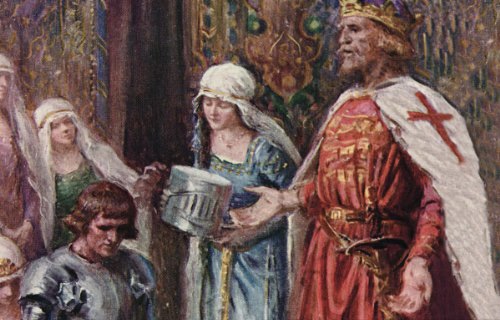
Symbolically, we tin can already run across the ideas that Sir Mallory wants u.s.a. to empathize about Rex Arthur as a character. He's a "chosen i", divinely picked by God and the leader of a bully Catholic Empire. By conquering Rome, he's unmarried-handedly inherited the legacy of the greatest culture in his time. More importantly, he's established himself every bit the inheritor of a civilization founded on a keen idea. Anyone who knows about Rome tin speak virtually just how powerful the "Thought of Rome" is as a civilizational principle. That the Romans existed to enhance and spread the attain of a neat and moral city-state beyond the world was the foundational centre of that society. Now, Le Morte D'Arthur has shifted that moral position to Camelot. Not but is King Arthur a mythical Christ-Effigy, but his kingdom has become the mythical representation of the City of God, the identify where Heaven touches Earth and where goodness and righteousness pour out across a great civilization.
Arthur himself is a symbol of Christ. As Robert Graves writes in the introduction to my Modernistic Idiom edition, "Arthur had been converted into a counter-christ, with twelve knights of the Circular Table to propose the twelve apostles, and with no second coming."
This becomes the context for the balance of the story and how it's told. In almost ALL Arthurian literature, Arthur is a secondary character. He'southward the gravitational centre past which all stories and events orbit, but he rarely factors into the plot as an individual character with his own desires. He'due south just the ultimate point of admiration, the loftier watermark of a swell civilization. He's the apotheosis of the mythical Good King who makes the world orderly and right merely past sitting on the throne. Le Morte D'Arthur is no different. Similar most Arthurian poetry, the story is about the Knights who serve under his command. From Volume Six to Volume Xix, the story becomes about what it's like to live as a Knight in the supposedly perfect society of Camelot.
This serves every bit the inevitable pb-in to the question that has to be asked next: how did information technology all fall autonomously? Merely as Augustine asked before him, how does the City of God collapse? How did Camelot, the story's divinely ordained kingdom of man, become corrupted to the point where it came crashing down? How could the human being called by God to create a great empire of godliness and chivalry fail so completely?
Only because you destroy every external threat doesn't hateful you lot've destroyed every internal threat. The Vikings, Romans, and Muslims may exist serving as Patrons of Camelot. Merely every bit the Ancient Jews constitute a way to destroy their kingdom of God and watched their Temple destroyed by their own sin, Camelot'south downfall would be entirely an internal collapse.

The Story Part 2: The Tales of Sir Lancelot, Sir Gareth, and Sir Tristan
At present is a adept time to mention that Le Morte D'Arthur is a securely idiosyncratic novel. At times it's strangely incohesive, episodic, long-winded, and contradictory. This is most axiomatic during the novel'southward longest segment. From Books Vi to Book XII, we're treated to the longest and most meandering segment of the work which follows the adventures of the round table as they travel amid their kingdoms, fight monsters, save women, and defeat evil kings. To be quite frank, this segment of the novel is repetitive and activeness-focused. There's hardly a single chapter that goes by without a joust, duel, or fight. One begins to wonder how many wandering knights existed in Uk and how information technology could've been possible for someone to have this many adventures walking through the English countryside.
Still, this segment is of import. This is the gold age of Camelot'south rule. Nosotros demand to see the Knights of the Round Table at their strongest and we also need to see the pocket-sized cracks forming slowly towards the edges of the story.
Book Half-dozen begins with the story's first mention of Sir Lancelot, who will keep to become the nigh notable and thematically important knight in the entire story. The book is about his early adventures. Lancelot Du Lac (Lancelot of the Lake) is established as the finest and more honorable knight in Arthur'due south early court. He makes himself a patron of Queen Guenever and earns status as the greatest knight in the state. He competes in tournaments, defeats monsters, and saves damsels from distress. Lancelot'southward famous infidelity with Guenever isn't mentioned this early, but the story here is ultimately edifice his character up. The volume ends with Lancelot returning to the Circular Table and receiving renown for his incredible feats.
Book VII similarly deals with the adventures of Sir Gareth. Similarly, these chapters are action-focused just explore Gareth's adventures traveling beyond the land in disguise to achieve bully deeds without necessarily being falsely modest and having these feats attached to his proper noun.
Book VIII begins the hardest, but arguably most important, segment of the quest in its retelling of the story of Sir Tristan. Tristan is 1 of the nigh important Arthurian knights, partially because his artistic tradition was older than the Arthurian stories themselves. Stories of Sir Tristan existed before the gilt age of Arthurian stories but were integrated into the mythos past prominent poets who tied his adventures to the Round Table and subsequently the Holy Grail quest.
The bones legend is fairly straightforward. Sir Tristian is a Cornish knight serving under the dominion of one King Marker. He's dispatched to Ireland to help save a distressed princess from a dangerous dragon and succeeds just manages to injure himself in the process. In thank you, the male monarch gifts his girl Iseult to Tristin with the expectation that she will be married to King Mark. Additionally, Iseult is gifted a wine bottle for her wedding night that'due south actually a powerful love potion that volition cause her to fall maddeningly in love with whoever else drinks information technology. By accident, the two drink the potion and autumn in love on the spot, consummating their affair on the boat to Cornwall. Iseult is eventually married to Male monarch Marker, simply the 2 maintain their illicit affair for a time until Tristin is either discovered by Mark or dies in battle with a fatal wound to his thigh (a symbol of sexual sin).
Mallory'southward retelling of Sir Tristin's adventures is arguably one of the weakest points in the entire novel. It'south almost 400 pages in some editions and diverges substantially from the original Tristin legend to the betoken where it's thematically and textually at odds with almost versions of the legend. Joseph Campbell summarizes Mallory's retelling of the Tristan story by proverb:
"Tristan is represented every bit one of the Knights of the Round Table; Mark is transformed into a cowardly dastard and a tyrant; and Tristan is slain by Mark himself, who thrusts a poisened spear into his dorsum while he is singing to Iseult in her bower."
Romance of the Grail, by Joseph Campbell, Page 114
Sir Mallory is far more forgiving of Sir Tristan than nearly writers of that legend. Tristan and Iseult both live out their days in Sir Lancelot'south castle and the story overtly approves of their love. This relates to ane of the more curious and unsettling elements of Le Morte D'Arthur's morality: information technology doesn't seem to spend much energy castigating some of the more than scandalous actions of its characters. Characters commit murders, casually commit adultery, and launch horrific wars with seeming impunity. At one point, Arthur orders an entire generation of majestic children executed when Merlin prophecizes one of them volition destroy him.
"Then King Arthur permit send for all the children born on May-24-hour interval, begotten lords and born of ladies; for merlin told Kign Arthur that he that should destroy him should be built-in on May-mean solar day, wherefore he sent for them all… and all were put in a transport to the sea, and some where four weeks one-time, and some less. And and so by fortune the ship drave unto a castle, and was all to-riven, and destroyed the almost part…"
Book I, Chapter XXVII
Actions like these speak to a foreign sense of immorality for a book that's subtextually about the destruction of a perfect kingdom. The book sparsely comments on these events from a moral perspective and just lets them play out. How can Sir Mallory defend Tristian'southward adultery and Arthur'due south murders?
Of course, it's hard to say if Mallory is overtly approving of these events or not. For 1, Arthur's murder serves as a quiet introduction for the graphic symbol of Sir Mordrid, his nephew who will become on to seize the throne in a Machiavellian power catch during the final book. Mordrid accidentally survives the murder and is raised in a regal family to eventually join the Round Tabular array. The seeds of destruction are planted early on in Arthur's career.
However, at times it'south hard to tell if Mallory is disinterestedly describing "historical" events or if he'due south purposely avoiding providing moral commentary at times. Thankfully, any splotches of moral gray exist in these segments are brought to the forefront in the next segment of the story.
The Story Part 3: The Quest for the Holy (San)greal
At last, we attain the volume's arguable highlight. The Holy Grail is the story element of the King Arthur mythos that most signifies the story of Arthur. It'south been a storytelling device in modern stories from Monty Python and the Holy Grail to Indiana Jones: The Concluding Cause. It's also a MacGuffin that's been somewhat obfuscated by its cultural attendance. Most people know WHAT it is, but they don't know where it comes from and what its artistic significance is within the Arthurian mythos. They know information technology's the loving cup Christ drank out of during the last supper and that his blood was captured inside information technology when Christ's side was pierced, merely they don't know why it'south usually hidden in Britain of all places.
To that cease, we need to consider the mythological origins of the Grail. As a story, it commencement appears in Chretien De Troyes' story of Sir Percival where it appears in a mysterious castle in the possession of a man named the Fisher King. Sir Percival is on a quest to notice his estranged female parent when the castle appears out of nowhere in his path. He's invited to dinner where a Grail and a bleeding lance are paraded into the dining room. Percival, a kind and quiet knight, says nothing and leaves after dinner.
Every bit information technology turns out, he's committed a massive fault. In Wolfram von Eschenbach's Parzival, we find out the Fisher King is the descendent of Joseph of Arimathea, the man who donated Christ's grave after the crucifixion. He caught Christ's claret with the Grail and was given possession of the spear that pierced his side. After the resurrection, he traveled to England where he handed down the artifacts to an order of nameless knights led past a Grail King who protects the Grail at all costs.
The Grail has special powers considering of its connectedness to Christ's blood. Anyone familiar with the Catholic Eucharist can speak every bit to why. When a person consumes the claret and body of Christ, they are believed to be literally partaking in Christ'south mankind. Considering the Grail was filled with Christ's blood, it has taken on the same qualities. To be in the presence of the Holy Grail is to be in the literal presence of Christ. It is for that reason the quest for the Holy Grail is mythologically significant. To be in the presence of the Grail is to signify spiritual and moral perfection.
Thomas Mallory'due south rendition of the Grail quest is radically dissimilar from De Troyes and Eschenbach'due south. Information technology draws heavily from the French Vulgate tradition where the Grail Knight isn't Sir Percival but Sir Galahad. Galahad'south name supposedly comes from the Hebrew word for "Mountain of Witness" and the entirety of his existence reflects this. He's a morally unquestionable virgin with a perfect intuition for perceiving right from wrong. He can perform miracles, heal wounds, and fifty-fifty reenacts Arthur's first accomplishment past pulling some other sword from another stone to signify he is a perfect knight chosen by God. The only impure thing about him is he's the illegitimate son of Sir Lancelot. In an before story of Le Morte D'Arthur, we find out Lancelot was brainwashed into sleeping with the girl of Male monarch Pelles, named Elaine.
This brought about the conception of Galahad who appears at Camelot on the feast of Pentecost. Later performing a handful of incredible miraculous feats, every knight in Camelot is gifted with a vision of the Holy Grail that convinces 150 knights to seek information technology out in person.
"Then anon they heard cracking and crying of thunder, that them though the place should all to-drive. In the midst of this boom entered a sunbeam more than clearer by seven times so ever they saw twenty-four hour period and all they were alighted of the grace of the holy ghost… Then there entered into the hall the Holy Grail covered with white samite, merely there was none might see it, nor who bare it. And at that place was all the hall fulfilled with good odours and every knight had such emats and drinks as he all-time loved in the earth. And when the Holy Grail had been borne through the hall, then the holy vessel departed all of a sudden, that they wist non where information technology became…"
Book XIII, Chapter Vii
There's an irony to the quest of class. Arthur's Round Table had been incomplete for years because a prophet had told him to proceed one seat open on the tabular array exclusively for the man who would be revealed to be the Grail Knight. When Sir Galahad arrived on Pentecost, he took the seat, and for the outset and concluding time, the Table Round was complete. Arthur really laments the quest because he realizes this night would be the just dark the entirety of the Round Table would be assembled all at in one case. This moment, the moment the perfect knight took his place, was the moral height of Camelot.
The journey ends upward taking near five years. Of the 150 knights that seek the quest, only four knights ultimately get to stand in the presence of the Grail: Lancelot, Bors, Percival, and Galahad. Lancelot is the beginning to observe the castle of the Grail, just when he arrives, he's warned not to enter the sleeping accommodation of the Grail.
"And so came he to the bedchamber door, and would have entered. And anon a vox said to him: Flee Lancelot, and enter non, for g oughtest not to do it; and if thousand enter thou shalter for-think it… Then looked he up in the midst of the chamber and saw a tabular array of silver, and the Holy Vessel covered with red samite, and many angels most it… Right so entered he into the chamber and came toward the table of silver; and when he came most he felt a breath, that him though information technology was intermeddled with burn, which smote him and then sore in the visage that him though it brent his visage; and therewith he fell to the earth… seemingly dead to all people."
Volume XVII, Chapter Fifteen
The holy burn down blast knocks Lancelot unconscious for 24 days for disobeying its directive. Lancelot was already intimately familiar with why he shouldn't have entered the chamber. In Book XV, Lancelot stumbles upon several hermits whom he asks for communication regarding hard questions in his quest. He admits his adultery with Elaine and that information technology has made him impure for the quest. Every bit he travels, though, he continues to brand mistakes. He keeps going downwards the wrong paths and embracing the path of sin over the path of good.
"For thou art so feeble of evil trust and good belief, this made it when chiliad were they took thee and led thee into the wood… thou should'st know expert from evil and vain glory of the world, the which is not worth a pear. And for great pride thou madest keen sorrow that thou hadst not overcome… and therefore God was wroth with you, for God loveth no such deeds in this quest. And this advision signified that thou were of evil religion and of poor conventionalities, the which wil make thee to fall into the deep pit of hell if thou go on the not."
Book 15, Chapter VI
Merely a perfect knight tin can come into the presence of the Grail. After Lancelot abandons his quest, Bors, Percival, and Galahad find it together, simply Galahad is revealed to be the true Grail Knight. For his perfection, perfect faith, and chastity, he'southward welcomed to Heaven and his soul is carried past a host of angels abroad from his torso. Sir Percival ends upwardly dedicating his life to faith and dies shortly after in a hermitage. Sir Bors is the just knight who witnesses the full glory of the Grail and who returns to Camelot.
"Come forth the retainer of Jesu Christ, and thou shalt encounter that m hast much desired to meet. So he began to tremble right hard when the deadly flesh began to behold the spiritual things. Then he held upwardly his hands toward heaven and said: Lord I thank thee, for now I meet that that hath been my desire many a day. Now blessed Lord, would I not longer live, if it might please thee lord… And therewith he kneeled down to-fore the table and made his prayers, so suddenly his soul departed to Jesu Christ, and a great multitude of angels blank his soul up to heaven, that the two fellows might well behold it."
Volume XVII, Chapter XXII
As glorious as it is, Mallory'due south rendition of the Grail Quest is a very dark and revealing story. That but three knights were worthy to stand in its presence out of 150 spoke poorly to the character of the Round Table. What were their sins? Even the mighty Lancelot was unworthy to stand up in its presence. Coming as tardily in the story equally it does, information technology too serves as a kind of prophetic warning. For if the Banquet of Pentecost represented the very height of Camelot's spiritual ascendency, the utter failure of 147 knights in that quest speaks to the torment and horrific tragedy nonetheless to come in the book's final chapters.
Equally C.S. Lewis writes:
"The Human tragedy becomes all the more impressive if we run across information technology against the background of the Grail, the failure of the quest becomes all the more impressive if information technology felt thus reverberating through all the human relationships of the Arthurian globe. No one wants the Grail to overthrow the Round Table direct, by a fiat of spiritual magic. What we want is to meet the Round Tabular array sibi relictus, falling back from the tiptop that failed to reach heaven and and so abandoned those tendencies within it which much piece of work it'south destruction. All the touches which Mallory added only make it more overwhelming…"
The Morte DArthur by C.S. Lewis
The Story Part iv: The Death of Arthur
Finally, we arrive at the book'due south inevitable conclusion; the moment the volume itself is named for and that every rendition of the Arthur story from Monmouth to White somewhen has to grapple with. It's the moment Le Morte D'Arthur has slowly foreshadowed and seeded across the unabridged narrative of the slice: the moment Camelot tears itself autonomously.
Naturally, such a moment doesn't arrive all at once. Shortly after Lancelot and Bors have returned from the quest, Queen Guinevere is captured by the evil Sir Meliagrance who holds her hostage at his castle. Repeating his famous feat from Chretien De Troyes' Knight of the Cart, Sir Lancelot charges out furiously to salvage his queen and kills his horse from burnout in the process. Nigh the castle, he jumps in a cart led past 2 men and demands them to bulldoze him to the castle (in the original story, this signified his cool desperation to reach her, equally noblemen don't ride peasant carts). Lancelot eventually manages to suspension her out and return her to Arthur.
Shortly after, though, Sir Mordred and Sir Agravaine stumble upon Lancelot'southward sexual affair with Queen Guenever. Upwardly until this point, the affair has been kept secret by the fact the queen is incapable of bearing children. With the discovery by Mordrid, Arthur is pb to the decision he must accuse his greatest knight with treason and similarly execute his wife. Twelve knights try to corner Lancelot, but he kills them all and escapes to safety. When word reaches him that his queen is to exist executed, he returns to Camelot and murders Sir Gareth to whisk her away.
Sir Gawain is then deeply disturbed past the murder of his brothers and friends that he swears vengeance upon Lancelot and the other knights similar Sir Bors and Sir Lionel that accept decided to stay loyal to him. Arthur gathers an army of knights and lays siege to Lancelot'southward castle, Joyous Gard. The siege lasts for several days and the full-calibration state of war betwixt Arthur and Lancelot reaps a bounty of blood and death. The state of war doesn't cool at all until the Pope himself intercedes and petitions for peace and negotiation betwixt both sides which briefly ends the fighting. Arthur commutes Guenever's expiry sentence and Lancelot delivers her back to him earlier departing for Normandy.
Arthur and Gawain again brand ready to war with Lancelot once more following the armistice and ready an army of 60,000 men to cross the English Channel amid an fleet of ships. Just as they begin their conflict once again, Arthur is forced to withdraw his entire force when he discovers Sir Mordrid has proclaimed to England that Arthur died in gainsay. He's declared king and even attempts to marry Guinevere to solidify his power. She refuses and locks herself in the Belfry of London.
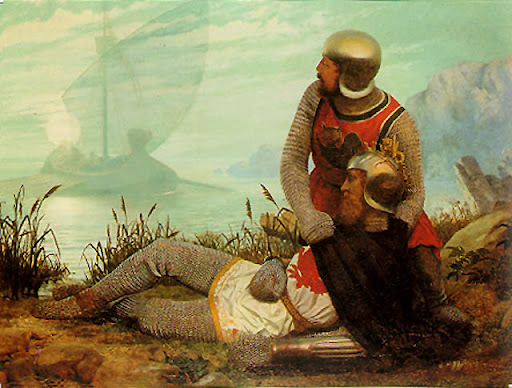
Arthur and Mordrid do intense battle from the shores of Dover to the fields of Camlann whereupon the last pathos of Camelot is laid bare. In their final battle, 100,000 men die and all but two of Arthur'south loyal knights are slain. Sir Mordrid dies by Arthur'south hand, but not without laying a mortal wound upon him. Arthur speaks that his wounded body is to exist carried away to the Island of Avalon to exist healed but that he may not render.
A tomb is set for Arthur with the cryptic words "Rex Old, Rexque Futurus" written upon information technology. Guinevere and Lancelot are left equally two of the only survivors of that horrific war, beset past sadness for their failures in honey, loyalty, and religion. Both dedicate the remainder of their lives to penitence, with the queen becoming a nun and Lancelot becoming a priest. The line of succession is handed to Sir Constantine of England, but those few surviving knights of the Round Table depart to their habitation countries to better serve their ain peoples. The peachy kingdom of Camelot is no more than and great trials are implied to beset England in its absenteeism.
"Notwithstanding some men say in many parts of England that Kign Arthur is non dead, merely had by the will of our Lord Jeus into another place; and men say that he shall come again and he shall win the holy cross."
Volume XXI, Chapter 7
And like that, Le Morte D'Arthur comes to a somber and painful conclusion. Sir Thomas Mallory's epic story brings its crescendo to its height and ends its tale of romance and gamble with an all too familiar bloodbath. It's difficult to imagine his contemporary noblemen wouldn't accept seen the plain reading of the text splayed out for them. They had but lived through decades of bloody civil state of war and violence. They had seen what happens when backstabbing leaders and disloyal warriors wreaked havoc. To them, Camlann would've felt like but some other battlefield. To run across the glory of that social club break down into such contemporary violence must've felt scathing.
Conclusion
I'1000 going to end this analysis by saying something that will probably harm my intellectual benefits, only information technology needs to be said regards. Arthurian stories are HAARRDD. I say that every bit someone who has read and enjoyed Homer and Milton. It took me MONTHS to end Le Morte D'Arthur, and that'south in addition to other Arthurian books I've started merely haven't finished.
Arthurian stories are insanely deep, insanely complex, and constantly contradict one another. They're caked in birdbrained medieval symbolism where arbitrary events happen specifically to serve equally an impetus; I just show up afterward and explain what the Christian meaning behind that event was. On meridian of that, almost of the stories are undecipherable unless you're actively familiar with the literary traditions, story structures, and cultural inclinations of the writers. Welsh, Latin, French, German language, and English Arthur tales have VERY different intellectual and artistic backgrounds that set them up.
King Arthur stories are not a franchise or a genre, they are a series of artistic traditions that spread beyond centuries and dozens of countries. It's nearly impossible to talk about 1 Male monarch Arthur story without tying the dozens of other interpretations into the discussion as a study in contrast. It doesn't help that the original sources for these series have been lost to history (or were entirely fabricated). Tracking some sort of singular ancestor is impossible.
Part of the fable'due south meaning comes in the ways these stories interact with ane another. In Wolfram Eschach's Parzival, he succeeds in finding the Holy Grail (which turns out to be a literal rock). In Tennyson's version, Percival fails. In both versions, the story of questing knights seeking the grail that held Christ'southward blood is a metaphor for knightly guiltlessness and man's ability to live upwardly to the edicts of God. Part of interpreting these stories has to come with the irony of grappling with why THIS version of the story ends differently than another 1.
On top of that, they can exist quite uncomfortable to read, as you must grapple with less godly elements that were popular during this time. The medieval concept of "Courtly Dearest" is suggests love for its own sake is a virtue and that adultery is forgivable so long as the couple is truly in love. This might've made some sense in a time when marriages were political arrangements. Even afterward Arthurian stories had to get miles out of their way to explore but how deeply sinful and apocryphal many of these early on romances were.
All that said, what makes the Arthurian mythos so deeply rewarding is how insightful and revealing the narratives are when they finally practise click. When I first read stories like The Once and Futurity King or Sir Gawain and the Green Knight, I found their complexity and item daunting. With each reading, they blossom as narratives with distinct and specific themes.
Mayhap Le Morte D'Arthur feels specially timely because it speaks to the same fear of dissolution that our ain fourth dimension seems to be dreading. Information technology is a time of incredible paranoia and doubt – political strife, economic suffering, racial tension, class division, climate change, religious tension, and so on. In that location is a great fear in society that i or more of these factors will be the affair that destroys either society or humanity as a whole.
Mallory'due south great insight is fundamental – there is no unmarried cause to the devastation of a order. Everybody has a hand in the proliferation of evil. The lust of Guinevere and disloyalty of Lancelot give way to murder. Gawain's vengeful hatred leads to war. Said war gives Mordrid the ambition to cease the throne, and the war between him and Arthur kills the surviving Knights of the Round Table.
At every step in this process, there was an pick to turn away from vice. None of them are individually responsible. Lancelot's actions may have started the ball rolling, just much had to happen in his absence for the kingdom to break apart. The virtuous option was ignored. Each modest act of sin builds upon the next until the entire court of Camelot is splayed out in a mass of blood and death upon the fields Camlann.
Maybe Caxton was serendipitously intuitive when he accidentally changed the title of the book to Le Morte D'Arthur. For a volume that's trying to tell such a huge story, no words truly capture the depths of its tragedy quite similar "The Death of Arthur". This is a story well-nigh death. At the heights of its triumph and glory, information technology tells you lot in its title to retrieve about how the events you're reading will eventually autumn apart. In that, it may notwithstanding exist 1 of the greatest stories of human frailty ever set to page.
Source: https://geeksundergrace.com/books/classic-review-le-morte-darthur-1485-ad/
0 Response to "Academic Reviews for Le Morte Darthur Knight of the Cart"
Postar um comentário